ADHD Body Doubling: How Virtual Accountability Improves Focus
Learn how virtual body doubling helps overcome task initiation paralysis, maintain focus, and build consistent habits. Includes research on executive function support, optimal session strategies, and comparison of accountability tools.

TL;DR: Virtual body doubling helps people with ADHD focus by working alongside others digitally. It provides external accountability that compensates for executive dysfunction, making task initiation easier without video calls or scheduling. Research shows external structure improves task completion, and the Pomodoro Technique works best when adapted to attention patterns (15-20 min for difficult tasks, 45-90 min when hyperfocused).
What is Virtual Body Doubling for ADHD?
Definition: Virtual body doubling is the practice of working alongside another person—either in-person or digitally—to improve focus, task initiation, and sustained attention. It provides external structure and accountability that helps compensate for executive function challenges. Unlike traditional accountability tools, it doesn't require active communication or supervision; the simple presence of someone else working is enough to anchor attention and reduce task-switching.
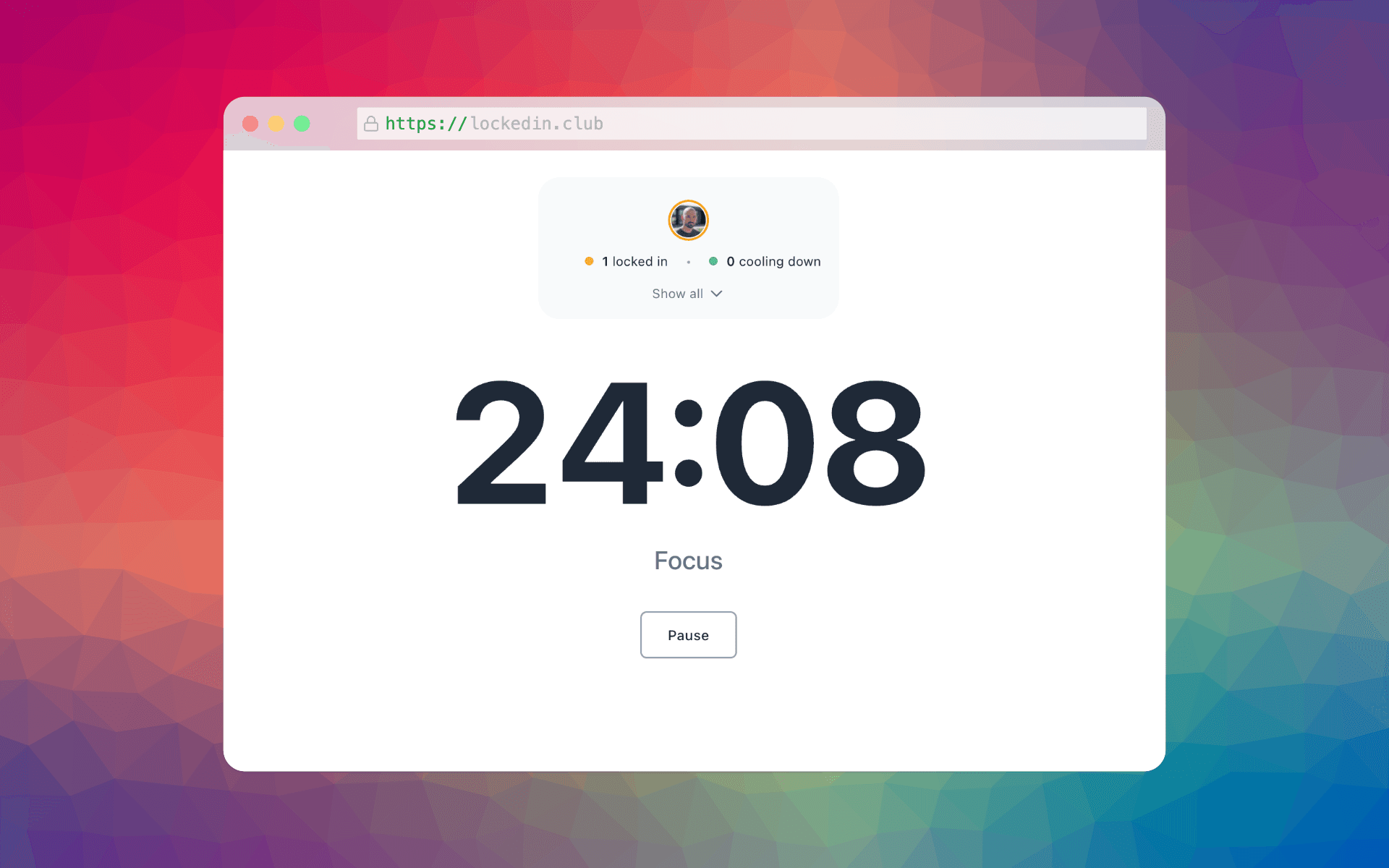
For neurodivergent individuals, the presence of others working creates external activation energy that bypasses internal resistance. Virtual body doubling extends this concept online—you can see when your accountability partners are in active focus sessions, creating the productive energy of a shared workspace without requiring video calls, scheduling, or real-time coordination.
According to CHADD (Children and Adults with ADHD), body doubling is particularly effective because it provides: external accountability that compensates for weak internal motivation, social mirroring that makes starting tasks easier, and ambient structure that reduces decision fatigue about what to do next.
Research: Why Body Doubling Works for ADHD
Multiple studies and clinical research demonstrate the effectiveness of body doubling and external structure for ADHD:
Key Research Findings
- •External structure improves task completion: A 2018 study in the Journal of Attention Disorders found that adults with executive function challenges demonstrated significantly improved task completion when external structure was provided (Knouse et al., 2018).
- •Social accountability reduces isolation: Research in Psychology Today (2025) indicates that body doubling creates friendships and sparks ideas while providing non-judgmental support for productivity struggles.
- •Mirror neurons facilitate task initiation: Neuroscience research shows that observing others performing actions activates similar neural pathways, helping people overcome initiation paralysis (Iacoboni, 2017).
- •Time structure compensates for time blindness: A 2019 study on time perception found that external time structure (like Pomodoro intervals) helps compensate for impaired temporal processing (Ptacek et al., 2019).
Executive Function & External Structure
Research published in the Journal of Attention Disorders shows that adults with attention challenges demonstrate significantly improved task completion when external structure is provided. Body doubling acts as this external scaffold, compensating for weak executive function without requiring conscious effort.
Social Accountability Impact
According to Psychology Today research, body doubling creates friendships and sparks ideas that may never have arisen in solo work. The practice reduces isolation while providing gentle accountability without judgment—critical for those who often experience shame around productivity struggles.
Mirror Neurons & Task Initiation
Neuroscience research on mirror neuron systems shows that observing others performing actions activates similar neural pathways in the observer. For those struggling with task initiation, seeing someone else working triggers activation energy that internal motivation alone cannot generate.
Pomodoro Technique for ADHD
Research on time perception in ADHD shows that external time structure (like Pomodoro intervals) helps compensate for time blindness. Shorter, defined sessions reduce overwhelm and make large tasks feel approachable—addressing a core executive function challenge.
ADHD is not a willpower problem—it's a brain wiring difference that affects executive function. Body doubling and the Pomodoro Technique work because they provide external structure that neurodivergent brains struggle to generate internally. This isn't about "trying harder"—it's about creating an environment where focus becomes easier.
Why Body Doubling Works Specifically for ADHD
Executive dysfunction creates unique productivity challenges: starting tasks feels difficult, inconsistent dopamine regulation affects motivation, time blindness creates urgency problems, and working alone removes external structure. Body doubling addresses all of these by providing social presence, accountability triggers, and environmental anchors for attention.
1. Overcomes Task Initiation Paralysis
Starting tasks feels impossible even when motivated. Seeing someone else working provides external activation energy—a push that bypasses internal resistance. It's easier to "join" an active session than to start from scratch.
2. Provides External Accountability Without Judgment
Unlike supervisors or check-ins, body doubling creates gentle social pressure without shame. Knowing someone can see you're working (or not) activates accountability—but it's supportive, not punitive.
3. Reduces Overwhelm with Time Structure
"Work on project" feels impossible. "Focus for 20 minutes" feels achievable. Pomodoro intervals break work into digestible chunks, reducing the paralysis that comes from seeing tasks as monolithic.
4. Anchors Attention Against Distractions
Attention often follows interest rather than importance. Social presence creates an anchor: the knowledge that someone else is working makes task-switching feel more consequential, helping you resist distractions.
5. Compensates for Time Blindness
Perceiving time passing accurately can be challenging. Timers provide external time awareness, and seeing others' session progress creates social time markers that help you stay oriented.
6. Builds Consistency Through Shared Momentum
Maintaining consistency can feel difficult. Seeing friends maintain streaks or work daily creates social proof that consistency is possible—and makes you want to match their energy.
Adapting the Pomodoro Technique for ADHD Brains
The traditional Pomodoro Technique (25 minutes on, 5 minutes off) needs adaptation for neurodivergent brains. Here's how to make it work with your brain, not against it:
Customize Session Length
Don't force 25 minutes if it doesn't match your attention span. Use:
- 15 minutes for difficult/boring tasks
- 25 minutes once you're warmed up
- 45-90 minutes when hyperfocused on interesting work
Honor Hyperfocus
If you're in hyperfocus when the timer rings, ignore it. Hyperfocus is a superpower—don't interrupt it with rigid adherence to breaks. Use the timer as a minimum commitment, not a maximum constraint.
Use It as a Starting Ritual
The hardest part is starting. Commit to just one 15-20 minute session. Tell yourself "I'll do one Pomodoro, then decide." Usually, starting breaks the paralysis, and you'll continue.
Add Social Accountability
Solo Pomodoro is better than nothing, but combining it with body doubling is transformative. Seeing others working gives you the external push to actually start your session.
Why traditional Pomodoro apps often fail: They assume internal motivation is enough to start the timer. When starting is the hardest part, body doubling solves this by making it a social act ("joining" a session) rather than a solitary willpower battle.
How to Use Virtual Body Doubling (Step-by-Step Guide)
Choose ONE Specific Task
Vague goals create unnecessary friction. Be specific: instead of "work on project," try "write outline for presentation" or "respond to 5 emails." One task per session reduces decision fatigue.
Set a Low-Stakes Timer Length
Start small to reduce activation energy:
- High resistance task? Start with just 15 minutes
- Medium difficulty? Try 20-25 minutes
- Interesting task? 30-45 minutes, but allow extending if hyperfocused
Connect with an Accountability Partner
Find someone—friend, coworker, online community member—who also uses body doubling. You don't need to work on the same task or even talk. You just need to know they're working too.
Eliminate Digital Distractions BEFORE Starting
Novelty-seeking can derail focus. Make distractions impossible: put phone in another room, close all browser tabs except work, use website blockers. Remove temptation before willpower is required.
Start the Session (Even If You Don't Feel Ready)
Motivation often comes AFTER starting, not before. Click start even if you feel resistance. The first 2-3 minutes will feel hard, then momentum kicks in. Body doubling helps because you're "joining" someone, not starting alone.
Take Breaks Away from Screens
Movement helps regulate energy. Stand up, walk, stretch, get water. Don't check phone or social media—those aren't breaks, they're dopamine traps that make returning to work harder.
Optimal Focus Session Lengths
| Task Type | Recommended Length | Why This Works for ADHD |
|---|---|---|
| High-Resistance Tasks (Boring/Difficult) | 15-20 minutes | Short commitment reduces activation energy. "Just 15 minutes" feels achievable even with high resistance. |
| Moderate Tasks (Routine Work) | 25-30 minutes | Standard Pomodoro length works once you're warmed up and attention is anchored. |
| High-Interest Tasks | 45-90 minutes | Leverage hyperfocus. Don't interrupt flow state with rigid breaks when genuinely engaged. |
| Morning First Session | 10-15 minutes | Lowest activation energy. Build momentum before attempting longer sessions. |
| Evening/Low-Energy Sessions | 15-25 minutes | Shorter sessions match reduced executive function later in day. Don't fight your energy curve. |
| Deep Work (After Warm-Up) | 90-120 minutes | After 2-3 shorter sessions, sustained extended focus becomes possible if the task is engaging. |
Best Practices for ADHD Focus with Body Doubling
Work WITH Your Energy, Not Against It
Energy levels naturally fluctuate with peaks and crashes. Schedule difficult tasks during your peak hours (often morning for many). Save easy/boring tasks for low-energy periods, or accept that some days you can only do 15-minute sessions.
Use Transition Rituals
Transitions between activities can feel jarring. Create a simple ritual before starting: make coffee, put on specific music, text your accountability partner "starting now." The ritual signals to your brain "focus time is beginning."
Externalize Your Task
Write down your ONE task for the session before starting. Goals can slip away mid-session. Having it written externally prevents task-switching when attention drifts.
Celebrate Small Wins
Feedback sensitivity makes acknowledgment powerful. After each session, recognize what you did—even if it's "I stayed focused for 15 minutes on a hard task." Positive reinforcement builds the habit.
Don't Shame Yourself for "Failed" Sessions
Some days executive function just doesn't cooperate. If you can't focus, that's brain chemistry, not character failure. Try again tomorrow. Body doubling helps by showing you you're not alone in the struggle.
Stack Sessions Gradually
Don't try to go from zero to four Pomodoros immediately. Start with one 15-minute session per day. Once that feels sustainable, add a second. Build capacity gradually rather than burning out.
Who Benefits Most from Virtual Body Doubling

Remote Workers
Working from home removes external structure. Body doubling recreates office accountability without video fatigue.
Students & Learners
Combat procrastination and maintain study consistency. Virtual body doubling provides structure for online learning.
Entrepreneurs
Building a business requires consistent execution. Body doubling provides accountability without formal teams.
Freelancers
Maintain client deadlines and manage multiple projects without external bosses or structure.
Creatives
Overcome creative blocks and maintain consistent output. Body doubling helps with both starting and finishing projects.
Anyone Struggling with Task Initiation
If starting tasks feels impossibly hard, body doubling provides the external push that internal motivation can't generate.
What Users Say About Body Doubling
"Friendly accountability and body doubling turned out to be the two key things I needed to effectively manage my ADHD."
University Professor
"Body doubling creates friendships and ideas that may never have arisen in solo brains. The calm witness provides nonjudgmental support."
Psychology Today
"Body doubling works because it provides external structure and accountability that the ADHD brain struggles to generate internally."
Children and Adults with ADHD
Common Challenges & Body Doubling Solutions
- Task initiation paralysis: Join someone else's active session rather than starting from scratch. "Joining" feels easier than "starting."
- Time blindness: Visual timer + seeing others' session progress creates external time awareness.
- Inconsistency: Social streaks and seeing friends work daily creates accountability that internal motivation can't.
- Isolation/shame: Seeing others struggle and succeed normalizes your experience. You're not alone or lazy.
- Hyperfocus interruption: Timer provides optional breaks, not mandatory ones. Extend when flowing.